
Heard County Released Inmates
A release means one agency's physical custody ended. At Heard County Jail, that can follow bond, a court order, time served, sentence completion, transfer, or another lawful direction. The sheriff records the local event. A court may hold the order that explains it. When the person enters a Georgia prison, GDC becomes the custody source. Parole adds Board and community-supervision records.
Heard County has no official public current roster or rolling recent-release feed on the sheriff website. Absence from a live list would not prove community release even if an unofficial list appeared elsewhere. The person may have transferred to GDC, another county, a hospital, federal custody, or immigration custody. A sound search follows the person across systems and confirms the destination.
How People Are Released from Heard County Custody
The release reason determines both the next source and the meaning of “released.” Bond permits a person awaiting court to leave after the judge-set amount and local processing rules are met. A court order can direct dismissal, time served, probation, or transfer. Sentence completion ends the jail term, but another hold can change the destination. Transfer ends Heard County custody without necessarily freeing the person.
| Type | What it means | Where to check next |
|---|---|---|
| Bond | Pretrial release after court and jail requirements | Court order and jail release sheet |
| Time served | Custody credit satisfies the ordered term | Sentence and release record |
| Transfer | Another authority receives custody | Transfer-out record and receiving agency |
| State release | GDC incarceration ends | Actual release date and current status |
| Parole | Prison ends before the state sentence fully ends | Board database and DCS |
| Probation | Court orders a community term | Superior Court and DCS |
What a Heard County Release Record Shows
A Heard County Jail release record belongs to the booking and jail-management trail. State-prison discharge data is split among GDC offender records, incarceration history, parole decisions, and supervision records. A court file may describe the event as a bond order, dismissal, sentence, probation order, or revocation instead of using the phrase jail release.
| Field | What it shows |
|---|---|
| Booking identifiers | The person and jail stay tied to the release |
| Release date and time | When Heard County custody ended |
| Release reason or type | Bond, order, time served, transfer, or other authority |
| Bond record | The bond form linked to release processing |
| Transfer information | The receiving agency when release was not home |
| GDC actual release date | The reported end of state custody |
| GDC current status | Active, parole, inactive, or another displayed status |
| Court disposition | The judicial event behind the custody change |
A release record does not by itself show that every pending case, detainer, registration duty, or supervision term ended. Read the destination and current status with the date.
How to Obtain a Heard County Release Record
Use the Heard County Sheriff's Office form. Identify the person, date of birth if known, and a booking or release range. Request the booking sheet, release sheet, release date and time, release reason, bond information, transfer information, and booking photograph if releasable.
- Choose a narrow, useful date range and supply known identifiers.
- Submit in person at 11820 Ga. Highway 100, Franklin, by mail to Open Records Request, Heard County Sheriff's Office, PO Box 339, Franklin, GA 30217, or by email to jolinger@heardcountyga.com.
- State whether inspection or copies are requested.
- Review any time and cost estimate before production.
- Use the response to verify the event against court or corrections data.
The form promises an answer within three business days after receipt, apart from holidays and emergency closures, and asks requesters to allow at least three business days after the incident. Charges may include the lowest-paid qualified employee's time after the first fifteen minutes plus copying costs. That initial lag is not a stated retention period.
Laws Governing Heard County Release Records
O.C.G.A. 50-18-70 states Georgia's presumption of public access. O.C.G.A. 50-18-71 covers access, timing, and fees, while O.C.G.A. 50-18-72 lists exemptions. The Heard County sheriff form cites sections 50-18-70 through 50-18-76.
Not every field is open. Juvenile, sealed, exempt, or restricted material needs separate treatment. Georgia uses record restriction under O.C.G.A. 35-3-37, not a broad promise that “expungement” erases every jail, court, and corrections copy. Court sealing, criminal-history restriction, record correction, and commercial-photo removal are different procedures.
How to Find a Released Heard County Inmate
Begin with custody type, not a broad name result. A local bond-out belongs with the sheriff and court. A state-prison release belongs with GDC. Federal and immigration transfers use separate systems. Parole or probation may continue after physical custody ends.
- For immediate local status, call Heard County Jail at (706) 675-3329.
- Search Georgia VINELink for custody status or a change alert.
- Check Magistrate Court for bond and first-appearance events and Superior Court for adult felony dispositions and sentences.
- Submit the sheriff form for the booking and release sheet.
- If the person entered a state sentence, search GDC by name, description, ID, or case number.
- Use the Board parolee database and DCS route for supervision.
- Use BOP for federal sentences and ICE ODLS for qualifying current immigration custody.
The Released Last 24 Hours page explains the same-day fallback when no official feed exists.
Georgia Department of Corrections Offender Search for Released Inmates
The GDC offender search applies only after a person enters Georgia state custody. Search by description, name, GDC ID, or case number. Compare identifiers and conviction county before accepting a match.
| Field | Release use |
|---|---|
| GDC ID | Direct state identifier |
| Name and birth detail | Find and distinguish matches |
| Case number | Connect the record to a sentence |
| Conviction county | Confirm the Heard case link |
| Maximum possible release date | State sentence maximum field |
| Actual release date | Reported state custody release |
| Current status | Active, parole, inactive, or another value |
| Incarceration history | State custody begin and end dates |
GDC asks users to verify results by writing Inmate Records and Information, PO Box 1529, Forsyth, GA 31029. The official entry screen is captured below.
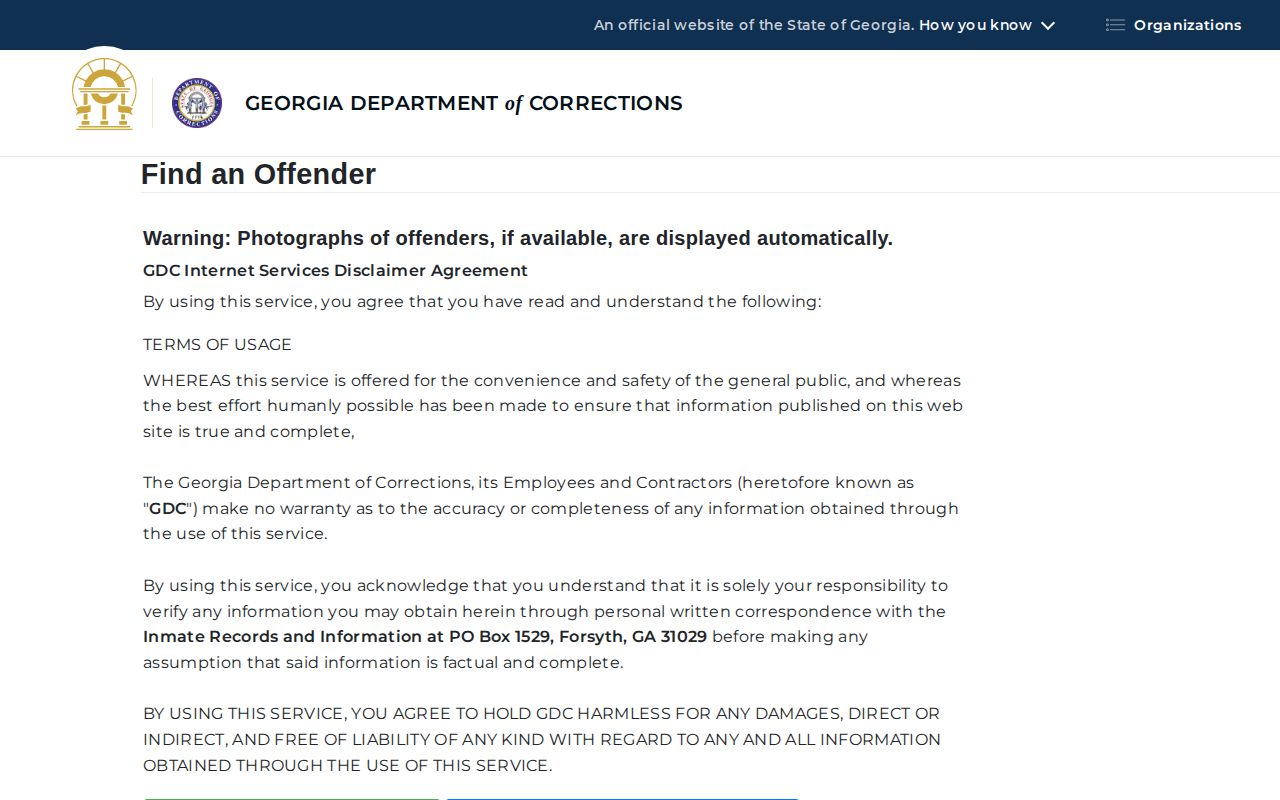
The disclaimer shown there makes written verification the final state-record step.
Do not confuse maximum possible release date with a Tentative Parole Month. The first is a GDC sentence field. The second is a Board marker for final parole review and can change with conduct, required programming, or other information. Actual release date and current status are the stronger fields after state custody ends. A parole status means the person left prison under supervision, while inactive status may reflect another discharge route.
Heard County Jail Releases and Recent Releases
No official Heard County 24-hour or 72-hour release list was found. The sheriff provides jail, bond, commissary, visitation, contact, and records pages, but no public rolling feed. No official sheriff mobile app for releases or mugshots was confirmed. Pay Tel Connect is for video visits, and JailATM and the Lockdown kiosk handle deposits. They are not search tools.
For a recent event, call the jail, check VINELink, inspect the relevant court event, and request the release sheet. Data can lag, and records functions may follow office hours though the jail is staffed all day. The sheriff's written three-business-day response standard is more reliable than an unofficial list.
Parole and Probation After Release
The State Board of Pardons and Paroles grants parole. DCS supervises parolees and adult felony probationers. Heard County Superior Court may order probation alone or after prison as a split sentence. A person may therefore leave custody while remaining under community rules.
Use the Board parolee database after release, the court sentence for probation, and DCS office navigation for supervision. TPM lookup is for parole timing before release and is not a final date. The Parole / Probation guide separates those records.
Release Notifications and Federal Releases
Georgia VINELink can return status and notifications from participating agencies. Search one person, confirm identity and agency, read the status exactly, and register for available app, phone, email, or text notices. Phone registration may ask for a four-digit PIN. VINELink is neither a certified release sheet nor a full archive.
Federal sentence records belong in the BOP locator. Released or Not in BOP Custody means BOP custody ended, but another system or supervision may remain. ICE ODLS applies to qualifying current immigration custody. A county release to ICE is a transfer, not community release.
Released vs Still in Custody: Where to Look
Each official source answers a narrower question. Match the source to the agency, then verify unclear results with the record owner.
| System | Current custody use | After release |
|---|---|---|
| Heard County Jail | Call for local status | Request release and transfer records |
| Georgia VINELink | Status and alerts when returned | May show released status, not certified proof |
| Heard courts | Bond and pending case events | Disposition, sentence, or probation |
| GDC | Currently serving and institution | Actual release date, status, and history |
| BOP | Federal facility or projected date | Released or Not in BOP Custody |
| ICE ODLS | Qualifying current immigration custody | Not a past county-release archive |
Heard County Detention Facilities
Heard County Jail is the active local detention facility. The sheriff operates it for Georgia felony and misdemeanor arrests and sometimes people held for other jurisdictions. A person may leave for the community, GDC, another county, or another lawful custodian. The release sheet and transfer field identify the path.
No separate state prison, federal prison, or ICE detention center appears in the Heard County facility map. Once the person enters those systems, use the statewide or federal record rather than treating the event as a local jail release.
The jail's official page reports a capacity of seventy and says trained, state-certified detention officers staff the facility around the clock. Office hours are listed as 9 AM to 5 PM on weekdays. That difference is important: an urgent custody check may be possible outside office hours, while a copy request, fee estimate, or records search may wait for administrative staff.
The sheriff's contact page and county directory should be used to confirm current routing before sending documents. A clear request sent to the right custodian is more useful than searching an unofficial roster that cannot certify a release.
How Heard County Bond Release Works
Heard County's bond rules are detailed. A judge sets the amount, not the sheriff. During business hours, cash bonds require USPS money orders or cashier's checks drawn on local Heard County banks. After hours, only USPS money orders or cash are accepted. Personal checks, business checks, and credit cards are not accepted. A court order can therefore precede physical release while payment and processing remain incomplete.
Property bonds require Heard County property and every deed or tax-receipt owner to appear with documents and identification. Out-of-county property bonds must be prepared by that county's sheriff and delivered in a sealed letterhead package. Professional companies must be authorized locally; detention staff cannot recommend one.
Correct Heard County Release Data
Use the office that created the disputed field. The sheriff reviews local booking and release records through in-person, mail, and email channels. GDC directs written verification of state offender results to Inmate Records and Information. The Clerk of Superior Court controls adult felony sentences and dispositions, while the Board and DCS hold parole and supervision data.
Give the person's name, booking, case, or GDC ID, quote the field at issue, and attach the official source that conflicts. The sheriff cannot rewrite a court order, and the clerk cannot change GDC status.
Separate correction from restriction. A wrong release time or status calls for the record owner to compare its source documents. Restriction under Georgia law concerns access to qualifying criminal-history information. A court seal concerns court material. These paths may affect what a public search returns, but none should be described as an automatic purge of every record held by every agency.
Heard Release Records at Court Square
Superior Court, Magistrate Court, and Probate Court services center on 215 East Court Square in Franklin. Superior Court is the adult felony source for dispositions, sentences, probation, and revocations. Magistrate Court can explain first appearances, warrants, committal hearings, and bond events. Probate Court chiefly handles traffic tickets and navigation, not general jail release status.
Georgia e-access may route searches through a provider and require an account. Contact the proper clerk when a case is missing or a certified copy is needed. The jail record shows custody ending; the court file often explains why.
The Clerk of Superior Court is at 215 East Court Square, with mailing at PO Box 249, Franklin, GA 30217, and phone (706) 675-3301. Magistrate Court uses the same physical location and phone (706) 675-3002. A caller should describe the case type and ask which office holds the requested adult record rather than assuming every release order comes from one court.
Active and Historic Heard Jails
The active Heard County Jail is the sheriff facility on Highway 100 N. The old jail associated with the Heard County Historical Center and Museum on Shady Street is not a current detention site. Release questions and record requests belong with the active facility.
The distinction prevents calls to a historic location after an old address appears in a map or local account. The active jail can release a person to the community or transfer that person to GDC, another county, or another authority.
The active jail page reports a capacity of seventy and says the facility is staffed around the clock by trained, state-certified detention officers. Its office hours are 9 AM to 5 PM on weekdays. An urgent custody question and an administrative record request therefore use the same agency but may be handled on different schedules.
Restrict Heard County Release Records
Georgia record restriction can affect criminal-history access, but it is not the same as deleting every jail, court, and corrections entry. GBI explains O.C.G.A. 35-3-37 and different procedures based on arrest date. Court sealing, record restriction, jail correction, and commercial photo removal are distinct.
Booking photographs have a separate rule. O.C.G.A. 35-1-19 restricts law-enforcement release when a photo may be published and payment demanded for removal. Ask only for releasable material and allow the sheriff to apply the statute.
For arrests after the date identified by GBI guidance, the prosecutor is the main restriction contact. Older arrests follow a path through the arresting agency. A person seeking a change should identify whether the disputed item is a GBI history, court record, sheriff record, GDC record, or online copy, since the correct office and legal remedy differ.
Public Record Search
Sponsored Results