
Booking Photos After Release
A booking photograph documents an arrest-processing event. It does not show whether a charge led to conviction, whether a case was dismissed, or whether the person remains in custody. After release from Heard County Jail, the underlying jail record can remain with the Sheriff's Office even though the person is no longer visible in a live custody system. A photo must therefore be read with the booking date, agency, case disposition, and release record.
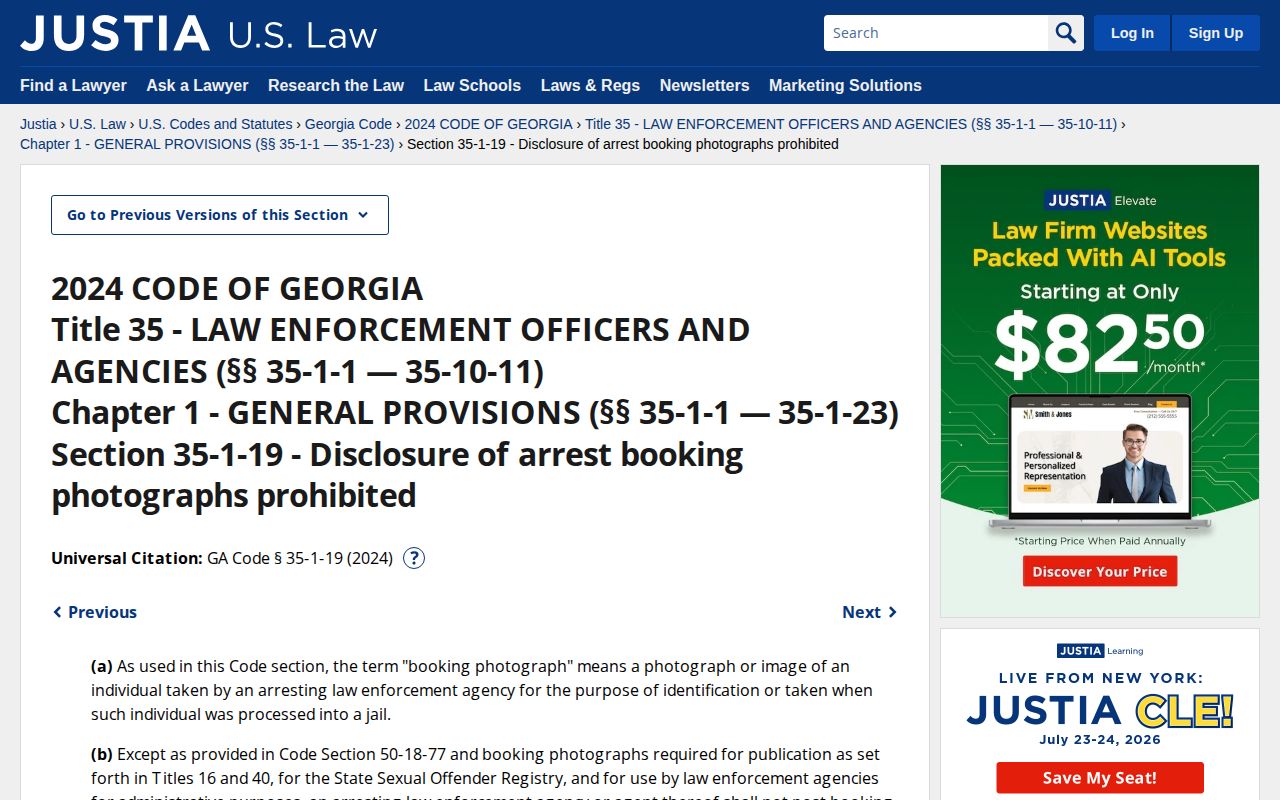
Georgia treats booking photographs differently from an ordinary assumption that every agency image is freely distributable. O.C.G.A. 35-1-19 restricts an arresting law-enforcement agency from providing a booking photo when it may be placed in a publication or posted online and removal would require payment or other consideration. A requester should not expect automatic production merely because the rest of a booking record may be available.
Where Heard County Photos Appear
The correct channel follows the custody type. A local jail booking photo belongs with the Heard County Sheriff's Office record. A photograph in the GDC offender search comes from state corrections and is not a substitute for the local arrest image. A registry photo has a separate statutory purpose and covers only people required to register.
| Channel | Has a photo? | How to access |
|---|---|---|
| Heard County sheriff roster or release feed | No confirmed public photo feed was found | Do not assume one exists; use the records-request route |
| Sheriff booking-photo request | Potentially, if releasable | Submit the official open-records form with identifiers and a date range |
| GDC Find an Offender | Photographs display automatically when available | Search the state record by GDC ID, name, description, or case information |
| Georgia Sex Offender Registry | May show registry photos | Use only for a person legally subject to registration |
| VINELink | Not promised as a photo archive | Use for custody status and notifications, not as the booking-photo record |
| Georgia Gazette or news | May reproduce a booking or case image | Treat as discovery only and verify with an official agency |
The Georgia Department of Corrections offender-search disclaimer and entry says offender photographs, when available, display automatically. Search results can also show current status, actual release date, maximum possible release date, most recent institution, sentence data, and incarceration history. Those fields help establish whether the image belongs to the correct released or inactive state record.
No Official Photo Feed or App
The official Heard County sheriff website did not present a current-inmate roster, 24-hour release list, 72-hour release list, recent-release photo gallery, or inmate-search page during the research sweep. No official sheriff mobile app for released inmates or mugshots was confirmed. That absence is important because a person cannot be found by scrolling a public Heard County photo feed that the agency does not publish.
The jail pages identify Pay Tel Connect for video visitation and JailATM or Lockdown for deposits. Those are service tools. They are not custody locators, release feeds, or mugshot apps. The Released Last 24 Hours guide follows the actual fallback chain: immediate jail contact when appropriate, Georgia VINELink, court records, and an open-records request.
Someone missing from an online page should not automatically be described as released. They may have used a different name spelling, moved to another system, transferred to GDC, or never appeared in the expected data channel. Local release confirmation comes from the sheriff's record and related court event, not from the absence of a photo.
Request a Heard County Booking Photo
The Heard County Sheriff's Office Open Records Request Form is the official local path. Georgia's Open Records Act, O.C.G.A. 50-18-70 through 50-18-76, favors public access while preserving exemptions and specific restrictions. A focused request is easier to identify and process than a demand for every record attached to a person.
- Identify the person by full legal name and date of birth if known. Add the booking date, release date, or a reasonable date range.
- Ask for the booking sheet, release sheet, release date and time, release reason or type, bond or transfer record, and “booking photograph if releasable under Georgia law.”
- Submit in person at 11820 Ga. Highway 100, Franklin, GA 30217; mail it to Open Records Request, Heard County Sheriff's Office, PO Box 339, Franklin, GA 30217; or email jolinger@heardcountyga.com.
- State the desired format or whether inspection is sufficient. Keep the request purpose-neutral and do not frame it around prohibited pay-to-remove publication.
- Retain the submitted request and any estimate. Compare the produced photo with identifiers and the release record before drawing a conclusion.
The sheriff's form says the office will answer within three business days after receipt, excluding holidays and emergency closures. If responsive records exist but are not immediately available, the response should describe them and provide a time and cost estimate. Search, retrieval, copying, and supervised-inspection charges may apply. After the first fifteen minutes, the office may charge the hourly rate of the lowest-paid full-time employee with the required skills and training.
The form also asks requesters to allow at least three business days from the incident date before submitting. That is a practical preparation period, not a rule that the photo disappears after three days. The Heard County release-record guide explains how the booking photograph fits with the release sheet and court record.
GDC and Registry Photo Limits
GDC is the strongest public photo path for someone who entered Georgia state custody. Its record may remain searchable after release and can pair an available photograph with an actual release date and inactive or parole status. Verify common names through GDC ID, birth information, conviction county, case number, sentence, and incarceration history. GDC directs users who need verification to write Inmate Records and Information, PO Box 1529, Forsyth, GA 31029.
The Georgia Sex Offender Registry, administered centrally by the GBI with agency-supplied information, may include a photo of a registrable released offender. The Heard County sheriff also links to the state registry. It is not a broad gallery of former inmates. Searching it is appropriate only when the person and offense fall within Georgia's registration law under O.C.G.A. 42-1-12.
VINELink serves a different function. Georgia VINE can provide custody-status checks and notification registration for participating agencies. A result may supply status, agency, and date or time depending on the feed, but it should not be promised as a historical photo source. Use VINELink Release Check to verify status, then return to the record custodian for the image.
Third-Party and Local Discovery
The Georgia Gazette Heard County category may surface booking or court-news material, and The News & Banner is identified as the county legal organ in GSCCCA information. Search engines may also return unaffiliated roster or jail sites. These channels can reveal that an image circulated, but they do not establish whether the person was released, transferred, acquitted, convicted, or remains under supervision.
Check the publication date, arresting agency, booking date, and any stated source. Then compare the information with the sheriff, Heard County Superior or Magistrate Court, GDC, VINELink, the Federal Bureau of Prisons, or ICE as the custody path requires. A third-party image can remain online long after the official record changes. It may also pair a photo with stale charges or omit a later dismissal.
Federal and immigration cases require their own systems. A BOP record can show Released or Not in BOP Custody, which means the person is no longer in BOP custody but may remain in another justice system or under supervision. ICE's locator addresses current ICE custody and certain CBP custody. Neither turns a Heard County booking image into an official federal or immigration release record.
Georgia Limits Pay-to-Remove Publication
O.C.G.A. 35-1-19 directly shapes the sheriff request. When a booking photograph may be put into a publication or website and deletion requires money or other consideration, the law restricts the arresting agency from making the image available. The practical result is that even a well-identified request may not produce every photo in every proposed use.
This rule is distinct from ordinary news reporting and from a request for a release record. It also explains why a Heard County page should never promise a downloadable mugshot for every former detainee. The lawful availability decision belongs to the records custodian applying Georgia law to the request.
Record Restriction and Photo Removal
Georgia generally uses the term record restriction rather than treating every cleared record as “expunged.” O.C.G.A. 35-3-37 governs criminal-history record restriction. The GBI explains different procedures for arrests before and after July 1, 2013: newer matters generally route through the prosecutor, while older matters use the arresting-agency path. Restriction of a criminal-history record does not automatically erase every news copy or third-party image from the internet.
The Georgia Attorney General's mugshot website guidance explains O.C.G.A. 10-1-393.5. A commercial mugshot website must remove a qualifying image without charge within 30 days after a proper written request when one of the statute's listed circumstances applies. Examples include restriction of access, no referral for prosecution, dismissal or nolle prosequi in covered circumstances, two no bills, certain qualifying program completion, or acquittal.
The request must include the person's name, date of birth, arrest date, and arresting agency. It must be delivered by certified mail with return receipt requested or by statutory overnight delivery to the proper business or contact address. Keep proof of delivery and documents showing the qualifying outcome. The Attorney General also notes permitted uses involving news, commentary, and advertising by specified media, so removal is not a universal command applicable to every publisher.
For an official record, ask the responsible agency how a restriction order affects public access and supply the order or disposition. For a third party, use its published correction or removal channel and cite the accurate outcome. Never pay an unverified demand merely because a page promises removal.