
Maximum, Tentative, and Actual Dates
The answer to “when will this Heard County person be released?” begins with the label attached to the date. In a Georgia Department of Corrections offender record, MAX POSSIBLE RELEASE DATE is the state sentence maximum-release field. ACTUAL RELEASE DATE reports the date GDC shows the person left its custody, while an active record may instead say the person is currently serving. CURRENT STATUS adds essential context, such as active, parole, or inactive. Incarceration history may show the beginning and end of a custody period.
A pretrial detainee at Heard County Jail normally has no calculated state-prison release date. Release may turn on a judge setting bond, accepted bond payment or property, dismissal, a court order, transfer, or later disposition. A court may authorize release before jail staff complete identity checks, holds, property return, and other processing. For that reason, a bond order and physical departure are related events, not necessarily the same time.
How to Find an Inmate Release Date
Choose the custody system before searching. GDC is appropriate for a person who entered Georgia state custody, even if the conviction occurred in Heard County. It is not a universal county-jail locator and will not establish that a local pretrial detainee bonded out. The GDC Find an Offender search supports name, description, ID, and case-number approaches.
- Determine whether the person was held locally at Heard County Jail or sentenced into GDC custody. Use the Heard County released inmate search guide when custody is uncertain.
- For state custody, search by GDC ID when available. Otherwise use the full legal name and compare birth information, conviction county, case number, major offense, and sentence details.
- Read MAX POSSIBLE RELEASE DATE, ACTUAL RELEASE DATE, and CURRENT STATUS together. Record the field names, not only the date.
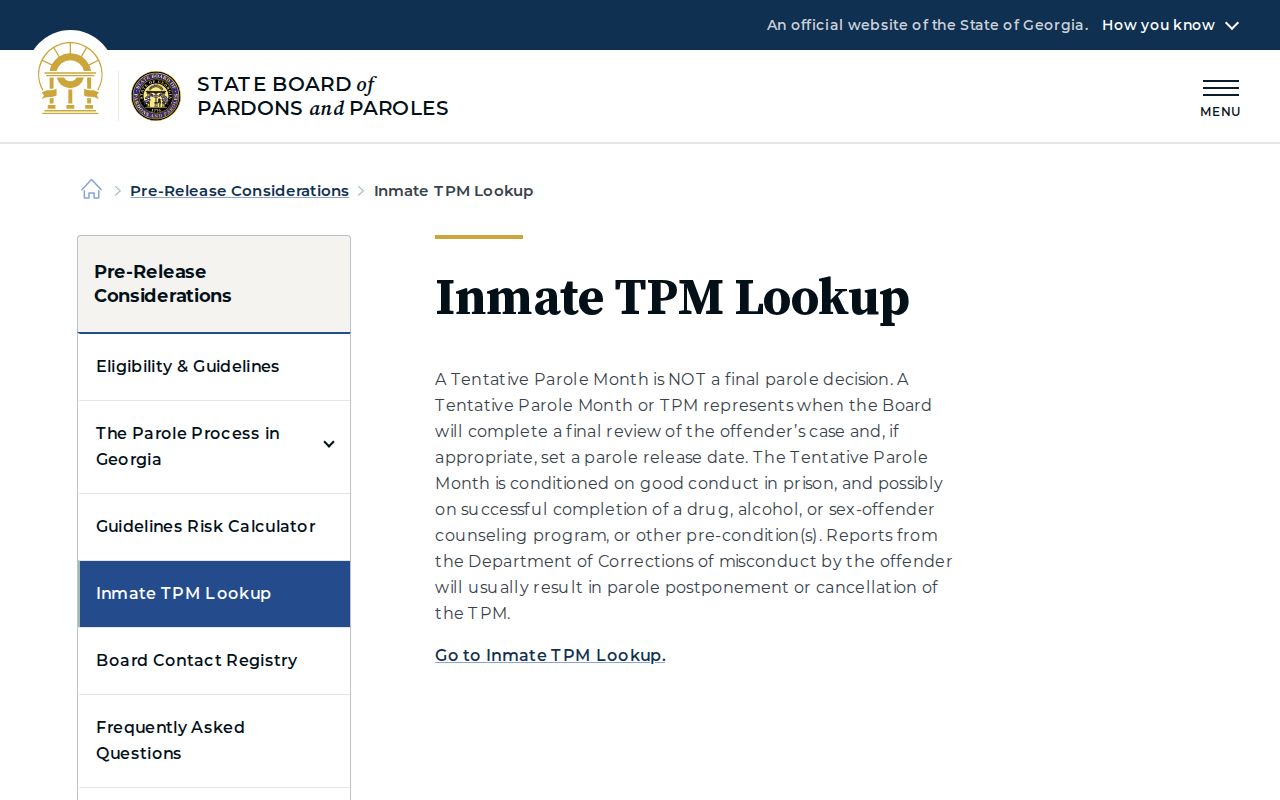
- For parole timing, use the State Board of Pardons and Paroles TPM explanation and lookup path. Do not translate a month into a guaranteed release day.
- For a local jail sentence, contact Heard County Jail at (706) 675-3329 and consult the sentencing or disposition record. Jail office hours are 9:00 AM to 5:00 PM Monday through Friday, although the facility is staffed around the clock.
- Request documentary confirmation when needed. GDC directs written verification to Inmate Records and Information, PO Box 1529, Forsyth, GA 31029. Local jail release records use the sheriff's open-records process.
A state search result may identify a most recent institution outside Heard County. That is normal after a Heard County conviction leads to GDC custody. Confirm the person by conviction county and sentence blocks rather than expecting the institution field to say Heard County.
The GDC search warns that its information is offered for convenience and is not warranted as complete or accurate. Written correspondence is therefore the verification channel for disputed or consequential date information. A screenshot or copied search result is useful for tracking what appeared on a given day, but it is not a certified release record.
Georgia Credit and Sentence Rules
Pre-sentence confinement can affect the administered sentence. O.C.G.A. 17-10-11 provides credit upon conviction for each day spent confined in a penal institution or facility, subject to the statute. Time held at Heard County Jail before a state sentence may therefore be part of GDC's calculation. The public-facing result is the date and sentence information shown in the state record; the sheriff does not calculate a state prisoner's maximum date.
Georgia's Performance Incentive Credit program supplies another documented adjustment mechanism. Eligible offenders can accumulate as many as 12 points through case-plan progress, education or vocational improvement, and detail or work assignments. GDC states that the program can potentially reduce a Tentative Parole Month or Maximum Release Date by one to twelve months. Eligibility and earned progress matter, so a reader should not automatically subtract twelve months from every record.
Parole eligibility is separate from earned credit. Under O.C.G.A. 42-9-45, misdemeanor and felony consideration uses statutory time thresholds unless another law applies. The Board explains the general misdemeanor threshold as six months or one-third of the sentence, whichever is greater, and the felony threshold as nine months or one-third, whichever is greater. Eligibility means the Board may consider the case; it is not a promise of release, and the Board notes that few receive parole at initial eligibility.
Serious-offense rules can remove or delay parole eligibility. The Board says non-life sentences for specified serious violent felonies committed on or after January 1, 1995 are not eligible for parole consideration under the SB 441 framework. Its list includes rape, aggravated sodomy, aggravated child molestation, aggravated sexual battery, armed robbery, and kidnapping. Life-with-parole timing also differs by crime date. These rules, O.C.G.A. 17-10-6.1, and the individual sentence must be read together rather than reduced to a single statewide percentage.
Why the Timeline Can Move
A date can change without the underlying public record being an error. Sentence credits, new court action, parole review, disciplinary information, and custody holds can affect different stages of release. The responsible source depends on the event.
| Factor | Possible effect | Best source |
|---|---|---|
| Performance Incentive Credit | Eligible progress can reduce a TPM or Maximum Release Date by one to twelve months. | GDC PIC information and offender record |
| Institutional conduct | Misconduct reports can postpone or cancel a TPM; rehabilitative efforts may support a limited advance. | Parole Board TPM guidance |
| Final parole review | The Board may set a parole release date, deny release, reconsider, postpone, or withdraw a prior decision before release. | State Board of Pardons and Paroles |
| Court order or sentence change | A corrected sentence, revocation, appeal-related order, or other court action may change custody calculations. | Heard County Superior Court and GDC |
| Detainer or transfer | Departure from one facility may lead to another agency's custody rather than release to the community. | Holding agency, release sheet, and receiving agency |
| Pre-sentence jail credit | Credited days may affect the administered state sentence. | Sentencing order and GDC record |
A detainer is especially easy to misunderstand. A local record may show that a person left Heard County Jail, while the transfer record shows continued custody with GDC, another county, federal authorities, or immigration authorities. “Released from this facility” does not always mean released into the community.
Maximum Date Is Not a TPM
Georgia's two prominent forward-looking fields answer different questions. GDC's Maximum Possible Release Date belongs to sentence administration. The Parole Board's Tentative Parole Month marks a period for final parole review and, if appropriate, the later establishment of a parole release date. A TPM is conditioned on good conduct and may also depend on completing drug, alcohol, sex-offender counseling, or another program.
The Board can issue a TPM or deny parole for a non-life sentence. It may also reconsider a decision up to the release date. For a life sentence, the outcome framework differs. The Parole / Probation guide explains how a person moves from incarceration to Board decisions and then, if released under supervision, to the Georgia Department of Community Supervision.
This distinction is Heard County's most important release-date safeguard. A person convicted in Superior Court may have a GDC maximum date, a statutory eligibility point, and a TPM at the same time. None should be relabeled as the actual date. Only the authoritative record showing the completed event should be used to confirm release.
Heard County Jail Date Checks
A local sentence served only at Heard County Jail does not automatically create a GDC offender record. Its end date depends on the court sentence, credit for time served, any applicable jail policy, and release processing by the sheriff. The research found no published Heard County-specific good-time policy or weekend-release rule. No such local reduction should be assumed.
For a pretrial person, check the event that could authorize departure. The sheriff's bond instructions state that a judge, not the sheriff, sets the amount. Payment form can affect practical timing: during normal business hours, cash bonds require a USPS money order or cashier's check drawn on a local Heard County bank; after hours, the sheriff accepts only cash or a USPS money order. Personal checks, business checks, and credit cards are not accepted for a cash bond.
The court record can explain a bond order, dismissal, sentence, probation order, or revocation, while the jail record establishes physical release or transfer. Heard County Superior Court's clerk is at 215 East Court Square, Franklin, and can be reached at (706) 675-3301 for the adult felony record path. Magistrate Court at the same court-square address, phone (706) 675-3002, may hold the first-appearance or bond-related record for a pretrial matter.
Confirm the Completed Release
Use VINELink Release Check for a one-person custody-status check or notification registration where the participating agency supplies data. A released result may show custody wording, agency, and a date or time, but VINELink is not a certified jail release sheet and does not promise a complete historical booking record.
For a Heard County Jail document, submit the sheriff's open-records form in person at 11820 Ga. Highway 100, Franklin, GA 30217; by mail to Open Records Request, Heard County Sheriff's Office, PO Box 339, Franklin, GA 30217; or by email to jolinger@heardcountyga.com. Identify the full name, date of birth if known, and a narrow booking or release range. Ask for the booking sheet, release sheet, release date and time, release reason, bond record, and transfer-out record.
The form says an answer will be provided within three business days after receipt, excluding holidays and emergency closures. If records exist but are not immediately available, the office supplies a description and a time and cost estimate. Administrative and copying fees may apply after the first fifteen minutes at the hourly rate of the lowest-paid qualified employee. For a state record, use GDC's written verification address instead. Matching the question to the records custodian is the final step between a projected timeline and a confirmed release.