
Heard Parole and Probation Differences
Parole and probation can both place a person under rules in the community, but they begin in different ways. The State Board of Pardons and Paroles decides whether an eligible Georgia state prisoner receives parole. The Georgia Department of Community Supervision, or DCS, then supervises that parolee. Probation comes from a court sentence. Heard County Superior Court may impose felony probation alone or after a prison term in a split sentence. Thus, a probationer may never have been released from a state prison, while a parolee has left incarceration before the state sentence fully ends.
| Point | Parole | Probation |
|---|---|---|
| Who orders it | State Board of Pardons and Paroles | Superior Court judge |
| Custody path | Follows release from GDC incarceration | May replace prison or follow it |
| Public starting point | Board parolee database and GDC record | Heard County court sentence and DCS office path |
| Who supervises | DCS | DCS for adult felony probation |
| How it ends | Parole discharge or sentence end | Court-ordered term ends or court grants discharge |
Verify Heard Post-Release Supervision
Start with the legal source that created the supervision. A jail status alone cannot answer whether a released Heard County person is on parole or probation. The Heard County Jail records physical custody and release. GDC records a state incarceration. The Board records parole decisions, and the Heard County court record explains probation. Matching those records is more reliable than treating one missing search result as proof.
- Search the GDC Find an Offender form by name, description, GDC ID, or case number. Confirm the person through identifiers and the conviction-county field.
- Read the actual release date and current status. A parole status indicates release from incarceration to supervision; inactive status may reflect a different discharge path.
- For a person already released on parole, use the Board's Parolee Database. The separate TPM tool is meant for parole timing before release.
- For probation, obtain the Heard County Superior Court sentence or disposition. It may show straight probation or a prison term followed by probation.
- Use the DCS field-office locator and Heard County directory to find the current reporting office. Office assignments can change.
- When a public result is unclear, request verification from the Board, DCS, court clerk, or GDC records office that owns the record.
The full county-jail release trail, including the sheriff records route and court fallback, is explained on the Heard County released inmates search page. That trail matters when a person left the jail on probation without entering GDC.
Heard Supervision Office Routes
DCS is the statewide agency for adult felony probation and parole supervision. Its field-office list identifies offices by circuit, areas served, address, and services. Research for Heard County points to the Coweta Circuit service geography and the Greenville listing, while the county directory also lists an Adult Probation Office contact. Because service areas and case assignments may shift, check both official directories before traveling or mailing documents.
Georgia Community Supervision
DCS statewide contact
2 MLK Jr. Dr. SE, Suite 866 E
Atlanta, GA 30334
(678) 783-4337
Monday-Friday, 8 AM-5 PM
Greenville field-office listing
559 South Talbotton Street
Greenville, GA 30222
Confirm that the office handles the specific Heard County case through the official field-office locator or the Heard County directory.
DCS handles supervision, not the sheriff. The Board grants parole but does not perform day-to-day community supervision. Heard County Superior Court imposes felony probation, yet court staff do not replace the assigned supervision officer. Keeping those roles apart directs questions to the office with the actual file.
Heard Supervision Conditions and Violations
Conditions are the rules attached to parole or probation. They can include reporting, approved residence requirements, treatment, payment duties set by the case, or limits written into the release or sentence documents. The exact terms come from the Board, court, and DCS case record. A general web page cannot show whether one person has complied, and VINELink tracks custody changes rather than the full set of supervision terms.
A violation allegation does not always mean that supervision has ended or that a person is back in jail. DCS may investigate, and the Board or court may take action within its authority. An absconder is a supervised person alleged to have stopped reporting or left supervision without authorization. No official public Heard County absconder or warrant list was found. Do not infer warrant status from a missing parolee search result. Contact the appropriate official agency, and use the sheriff only for county warrant questions. A detainer from another authority may also change where the person goes.
Note: A custody alert can signal a return to confinement, but it does not explain the claimed supervision violation.
Heard Parole Timing and Decisions
The Board automatically considers eligible GDC prisoners for parole; they do not submit a parole application. Eligibility is not a promise of release. Board guidance says most parole-eligible prisoners reach consideration after one-third of the sentence, while O.C.G.A. 42-9-45 supplies the statutory framework. Other laws exclude some sentences, including listed serious violent felony non-life sentences based on offense and crime date, fourth-or-more felony recidivist sentences, and life without parole.
The Tentative Parole Month lookup applies before release. A TPM marks the month for final review and possible setting of a release date. It is not the release date. Conduct, treatment conditions, new information, or a detainer can lead to postponement, cancellation, or a different outcome. Once release on parole occurs, the parolee database and DCS route replace TPM lookup as the useful public paths.
The Board can grant, deny, reconsider, postpone, cancel, or withdraw a planned release before it takes effect. It may also parole a person to a detainer, called a conditional transfer. In that event, leaving GDC means transfer to the authority that filed the detainer, not a return home.
Heard Parole Meetings Explained
The Board posts public meeting notices through its press-release area. These notices should not be read as a calendar of individual Heard County parole cases. The Board's notice for its January 2026 monthly meeting expressly said offender cases would not be discussed or considered at that public meeting. Individual case timing belongs in the TPM lookup before release or the parolee database after release.
This distinction prevents a common error. A public Board meeting is agency business, while parole consideration is an administrative case process. For a Heard County conviction that led to GDC, use the GDC record to identify the person, the Board tool for parole timing or status, and DCS for community supervision. The sheriff neither decides parole nor calculates the TPM.
The official Georgia parole-process page shows the decision path and eligibility limits.
This official parole-process view is captured below. It places Heard County state-sentence questions in the statewide Board process rather than a local hearing calendar.
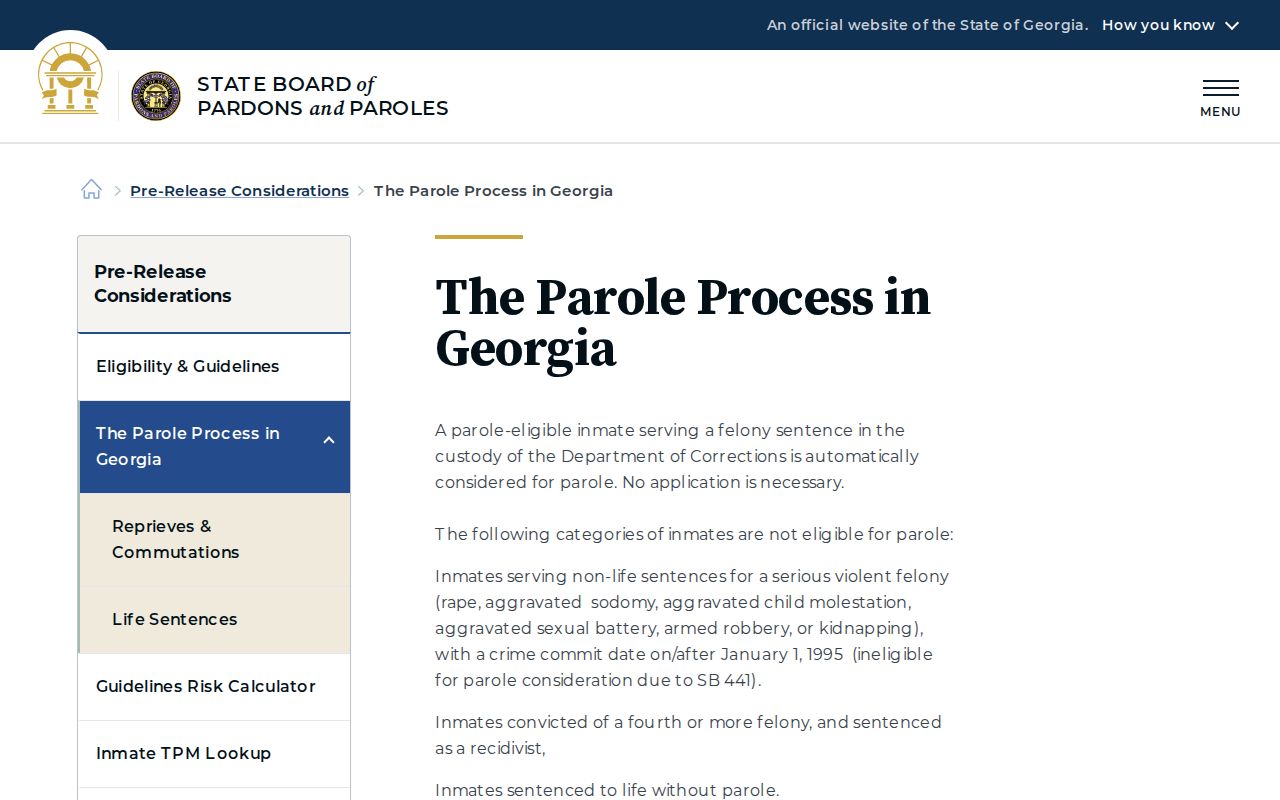
The image reinforces that parole eligibility, review, and release outcomes are controlled at the state level.
Correct Heard Supervision Records
Release and supervision data can sit in several files. For a local jail record, the Heard County Sheriff's Office open-records form accepts requests in person, by mail, or by email and states a three-business-day response standard. For a state custody record, GDC directs users to verify the offender-search entry in writing with Inmate Records and Information at PO Box 1529, Forsyth, GA 31029. A court sentence or probation order belongs with the Heard County Clerk of Superior Court.
Ask the office that created the disputed field to review it. The sheriff cannot correct a Board parole decision. DCS cannot rewrite a Superior Court sentence. GDC should verify its actual release date, current status, and incarceration history. A focused request should include the person's full name, relevant ID, case number if known, and the exact field believed to be incomplete.
Note: Georgia record restriction is a separate legal process and does not automatically rewrite every custody or supervision record.
How Heard Supervision Ends
Physical release and supervision discharge are different dates. A person can leave GDC on parole and remain supervised until the Board discharges parole or the sentence ends. A probationer remains subject to the court order until its term ends or the court grants an authorized change. Completion should be verified from the Board, DCS, or court record that controls the case.
For parole, check the Board's post-release tool and seek official confirmation when the displayed status is unclear. For probation, obtain the final court entry and ask DCS about the public confirmation route. If a person completed incarceration without parole or probation, the GDC actual release date and inactive status may document the state custody end. Those records do not prove that every unrelated case, hold, or registration duty ended.
A registrable offense follows another path. The Georgia Sex Offender Registry covers only people required to register under Georgia law. It is not a broad supervision list, and an entry should not be used to infer the status of someone who is not legally within that registry.
Public Record Search
Sponsored Results