
Heard County Same-Day Release Sources
The Heard County Sheriff's Office does not provide an official 24-hour release feed, current-inmate roster, or recent-release archive on its public website. The official Heard County Jail page gives facility information and a jail phone line, but its jail menu does not offer a browseable list of today's releases. That makes the fallback chain the primary route: ask the jail about immediate custody status, check Georgia VINELink, review the court record, then request the release sheet.
A missing name proves little by itself. The person may have bonded out, completed a sentence, moved to another county, entered GDC custody, or been handed to another lawful custodian. A same-day check must identify both the time and the kind of movement. Release from Heard County Jail can be a community release or a transfer-out, and those outcomes lead to different records.
Check Heard County Releases Today
Begin with the source closest to the event. Heard County Jail is staffed around the clock, though records work may follow office hours. Georgia VINELink can supply a custody status or notification where the participating agency sends data. Court files may show the bond order, dismissal, sentence, or other act that explains why jail custody ended.
- Call Heard County Jail at (706) 675-3329 for immediate custody-status routing. Give a full name and another identifier if known.
- Search Georgia VINELink. Read the status exactly and note the agency and release time if displayed.
- Check Heard County Magistrate Court for a first-appearance or bond event, or Superior Court for an adult felony disposition.
- Submit the sheriff's open-records form for a booking and release sheet when a documented answer is needed.
- If the movement was a state transfer, use the GDC Find an Offender search instead of treating it as a community release.
For one named person whose custody path is uncertain, the broader Heard County released-inmate search separates local, state, federal, and immigration channels. That distinction prevents an unsuccessful jail check from becoming an unsupported release claim.
Heard County Release Record Fields
There is no public Heard County list whose displayed fields can be promised. The following items are available across the official request, court, VINELink, and GDC channels. Ask for them by name so the response distinguishes a true release from a transfer.
| Field | What it establishes |
|---|---|
| Booking identity | Full name, booking number, and the jail event tied to the request. |
| Release date and time | When Heard County custody ended, if recorded and releasable. |
| Release reason or type | Bond, court order, time served, sentence completion, or another authority. |
| Bond record | The bond route and related court event; the judge, not the sheriff, sets the amount. |
| Transfer information | Whether custody continued with GDC, another county, or another custodian. |
| Court disposition | Case number, charge, bond order, sentence, dismissal, probation, or revocation entry. |
VINELink generally focuses on status and notifications, not a certified release sheet. A GDC result may add actual release date, maximum possible release date, current status, institution, sentence, and incarceration history after a state transfer.
Request Heard County Release Proof
The open-records form is the official documentary route when no same-day feed exists. Identify the person, date of birth if known, booking date or a tight date range, and the likely release date. Ask for the booking sheet, release sheet, release date and time, release reason, bond information, and transfer-out details. A precise request reduces the chance that the office must search unrelated files.
The sheriff states that a response is provided within three business days after receipt, excluding holidays and emergency closures. If a record exists but is not yet available, the office can describe it and give a time and cost estimate. The form also asks requesters to allow at least three business days after the incident before requesting records. That is a readiness lag, not a public retention window.
The wider Released Last 72 Hours process is often better once a weekend or records delay spans more than one day.
Heard County Custody Versus Release
A still-in-custody status means the agency continues to hold the person. A released status means that agency's custody ended. Neither label alone states where the person went. Someone can leave Heard County Jail on bond and return to the community, or leave by transfer and remain confined elsewhere.
| Status | Best confirmation | Next record |
|---|---|---|
| Local custody | Heard County Jail and VINELink | Booking or custody record |
| Community release | Sheriff release sheet and court order | Disposition or supervision record |
| State transfer | GDC offender search | State sentence and incarceration history |
How Heard County Bond Release Works
The sheriff's local bond instructions explain why a judge-set bond does not always produce an instant release. Cash, property, out-of-county property, and professional bonds use different processes. The sheriff states that the judge sets the amount; jail staff apply the published bonding rules and process accepted documents or payment.
The official bond page can be viewed in the Heard County Sheriff's Office source.
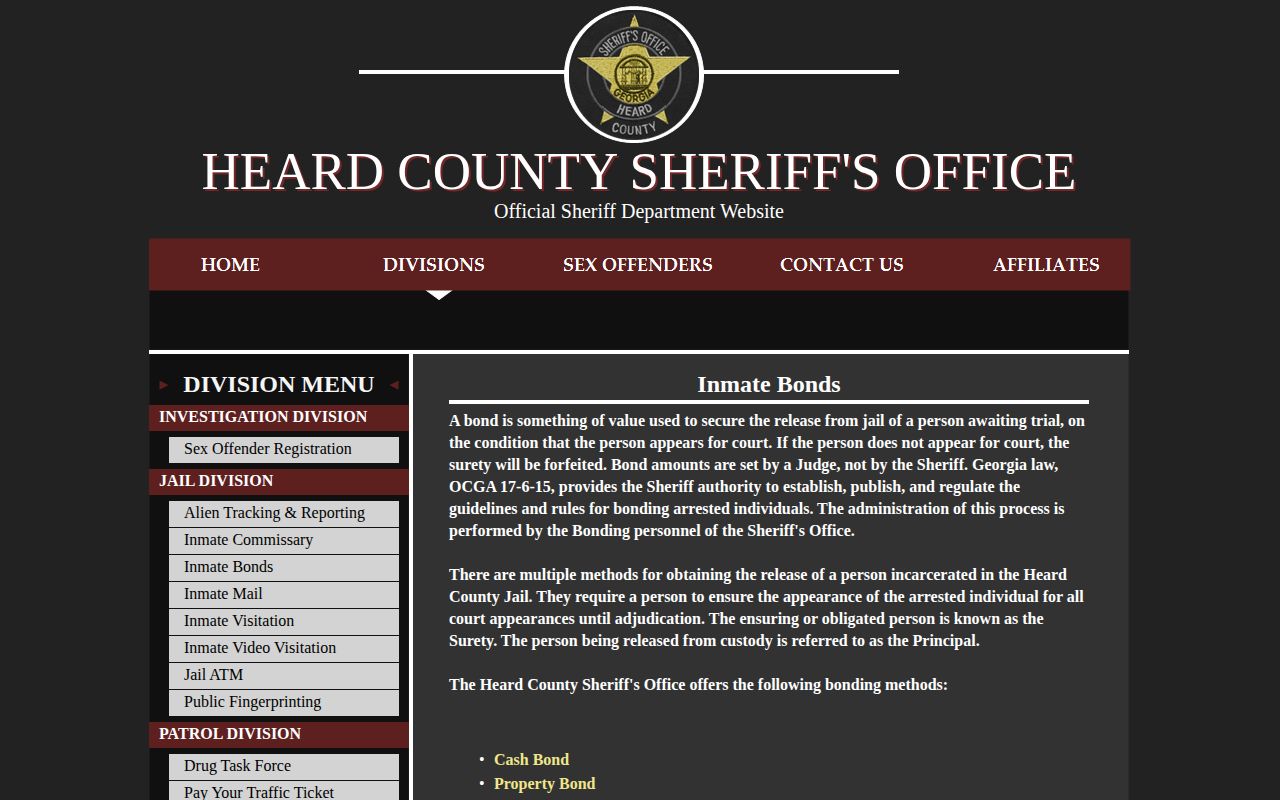
The captured page supports the local payment and property-bond details that can affect when a same-day release is processed.
During normal business hours, cash bonds require a USPS money order or a cashier's check drawn on a local Heard County bank. After hours, the accepted forms are USPS money order or cash. Personal and business checks and credit cards are not accepted. A property bond uses private Heard County property, and each person on the deed or tax receipt must appear with the required property papers and government-issued photo identification.
Property outside Heard County follows another path. The sheriff in the county where the property lies must prepare the bond and deliver it in a sealed package on that office's letterhead. A professional bonding company must be registered and authorized in Heard County. These steps can create a gap between the court's bond decision and the jail's recorded release time.
No Heard County Release App
No official Heard County sheriff mobile app for recent releases was confirmed. Pay Tel Connect appears in the sheriff's video-visitation information, while JailATM and Lockdown appear in commissary or deposit information. Those services handle communication or funds. They are not custody locators, release alerts, or same-day release feeds.
Georgia VINELink is the relevant notification channel. Even then, its result is a status aid rather than the county's certified release sheet. Preserve the wording and time shown, then use sheriff or court records when the exact legal basis for release matters.
Heard County News Needs Verification
Local case news and booking coverage may surface through nonofficial publishers, and GSCCCA identifies The News & Banner as Heard County's legal organ. Such coverage may help locate a case name or date, but it is not proof that a person was released today. Publication schedules also differ from jail processing.
Route any lead back to the sheriff, the correct Heard County court, GDC, or VINELink. A news item can describe an arrest long after custody changed, while a court docket can show the order behind the change. Official records remain the sound way to separate an old booking from a same-day release.
Use the matching source for the custody path. That simple check guards against treating a transfer, stale story, or service-app screen as a Heard County release.
Heard County State Transfer Checks
A move from Heard County Jail to the Georgia Department of Corrections is a release from local custody only. It is not a release from confinement. The GDC offender search accepts a name, description, GDC ID, or case number. An exact ID is strongest when names are alike. Once the correct record opens, compare current status, most recent institution, sentence information, and incarceration history.
Three GDC fields deserve separate treatment. Maximum possible release date is the state sentence maximum field. Actual release date shows when GDC records a release, or the record may state that the person is currently serving. Current status can indicate active custody, parole, inactive status, or another recorded condition. Together, those fields prevent a county transfer date from being mistaken for a state discharge date.
GDC warns that its public search is a convenience and does not warrant complete accuracy. For written verification, its disclaimer directs inquiries to Inmate Records and Information, PO Box 1529, Forsyth, GA 31029. Use that path when a public result and the Heard County release sheet appear to conflict.
Federal and immigration transfers also leave the county channel. A federal sentence belongs in the Bureau of Prisons locator, while an immigration hold may lead to ICE custody. Neither should be described as a person returning to the community without proof from the receiving system.